The agricultural revolution took thousands of years. The industrial revolution a century and a half. The digital revolution a few decades. The computing power behind AI doubles every five months. Three years from now that is more than a hundred times as much.source
With people and organizations, every next step costs more effort than the one before. Structures have to move with it, processes have to move with it, incentives have to move with it, and culture moves slowest of all. That is not unwillingness. It is simply how change works.
On top of that, the acceleration is not even. Models help build better models and investment scales along with them, while power grids, chip factories and the limited supply of usable data hold it back. You do not get a steady climb but waves, each following the last more quickly. And you cannot plan around a wave whose timing you do not know.
The curve is the same for everyone. The difference is in how fast you can follow it, and that difference grows every month you wait.
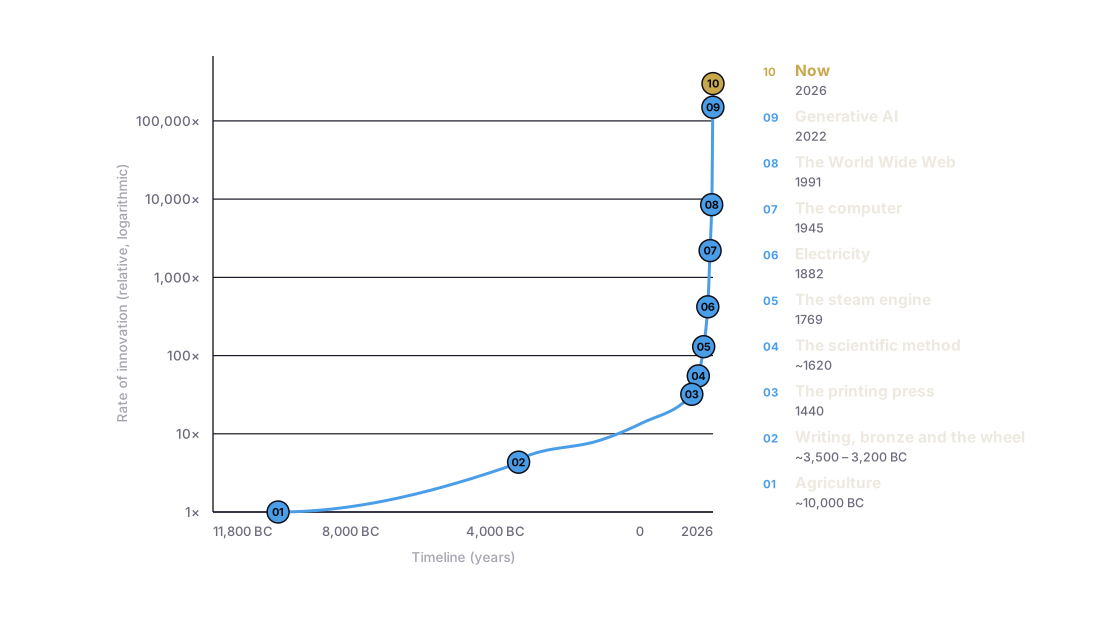
How to read this chart. The vertical axis is logarithmic: each line up is ten times the line below it. That is how nearly twelve thousand years fits into one picture, and it is why the steep final stretch is easy to underestimate. From agriculture to the printing press took more than eleven thousand years for roughly thirty times as much; from the printing press to now, six hundred years for almost ten thousand times as much.
Adopting faster is not a strategy. You will not catch up; there is always another wave. Anyone who organizes around keeping pace with technology keeps running behind the facts.
The one variable you do control is how fast your people grow.
That is why the question shifts. Not: how do we roll out this technology. But: how do our people get stronger, with AI as support and not as the goal.
It is also the only route that pays for itself. People who are in their strength pick up every next wave on their own. People who are put through an implementation have to be brought along again with every wave.
That is what we mean by: adoption starts before the technology.
The question is not whether AI is going to change your work. That is settled. The question is who leads that change.
When we work with boards, management and teams, the conversation always arrives at the same three. They sound abstract until you fill them in for one role, one team, one organization.
Routine work shifts to AI. The room that frees up asks people to lean on what sets them apart: judgment, instinct, context. That does not happen by itself. It takes development.
When AI takes over the how and the what, people can turn to the why and the when. That activates potential still lying dormant in many organizations.
AI puts you at the wheel, if you choose that deliberately. Organizations that teach their people to use AI as a partner rather than as a replacement build a lead that lasts.
Empathy, intuition and connection, for years dismissed as "soft" qualities, become the hard currency of the next phase.
Organizations that ignore this optimize themselves into a place where they look more and more like AI, and less and less like themselves.
Organizations that use AI to make their people stronger are the ones that will end up making the difference.
AI changes what is possible.The core of everything we do
People decide what matters.
Every AI implementation reflects values and choices, even though it often does not feel that way.
For organizations that means thinking about responsibility, governance and culture with every application. Not as an afterthought, but as part of the design.
For individuals it is about professional identity and a moral compass. Anyone using AI has to keep asking: am I doing this because it is right, or because it is possible?
Our view did not come about in a vacuum. It was shaped in part by the work of futurist and author Christian Kromme, whose books Humanification and The Human Spark have had a lasting influence on how we think about technology and humanity.
His core idea is as simple as it is powerful: technological development follows the same patterns as biological evolution. What begins as a small, isolated experiment accelerates along the same wave motion by which life has scaled itself up through history. Recognize that pattern and you see not only what is changing, but also when and how fast.
We have translated that idea into the practice of organizations and people. Not as a philosophical starting point, but as a concrete order in which you work out where your own distinctiveness lies, and how you strengthen it while AI takes over the rest.
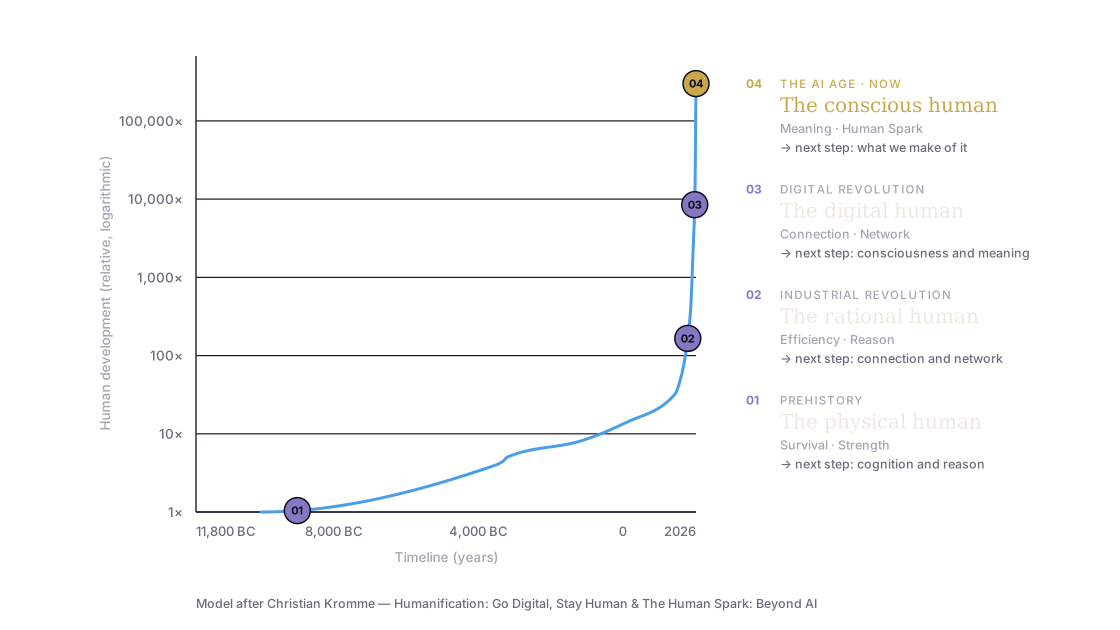
Below, human development is plotted on exactly the same line as the innovation curve above. That is the heart of the model: people and technology move along the same pattern, and both of us are in the steep part.
How to read this chart. The same timeline, the same line and the same logarithmic scale as above. Only now the vertical axis carries human development instead of the rate of innovation. That both curves have the same shape is the heart of the model: people and technology move along the same pattern. Each phase points to the next, from strength to reason, from reason to connection, from connection to meaning, and we stand at the beginning of the fourth. This curve is also where the Humanxt.ai logo comes from: the same line, the same points, with the gold point on now.
We are now in the middle of phase 4: the phase in which intelligence detaches itself from people. That is not a threat. It is an opportunity, if you handle it deliberately.
We are not AI evangelists who embrace every hype without question. Nor are we doomsayers who see AI as an existential threat.
That is not a middle ground. Critical and hopeful are not extremes you have to choose between. They are two attitudes you can hold at the same time, and it is that combination that is rare.
We are critical thinkers who believe technology is there to serve people, and that this is a deliberate choice someone has to make.
What we are critical of, we say out loud. That AI invents things that do not exist, with complete conviction. That anyone who trusts it blindly stops training their own judgment. That the distance grows between those who learn to work with it and those who never get the chance. And that every conversation with an AI is also data: about you, your work, sometimes your family.
We work those risks out in our book, with three cases where it really went wrong. The sharpest of them did not come from someone rushing alone, but from one of the world's largest consulting firms, with a full quality process behind it. So control is not a matter of being careful. It has to sit in the process.
AI interests us not because it is clever, but because it forces us to look again at what is human and who we are.
Humanxt.ai stands for the next step for humans in the AI age. Not the next step for AI, but for people.
Let's look at what that means for your organization.
Get in touch See our services