From the first spark to embedded practice: we guide organizations through the AI transition with people as the starting point.
You start where you are. Each phase builds on the one before it and ends with something tangible. Not a process that only pays off at the very end.
Governance, compliance and ethics runs through all of it, and weighs more heavily the further you go.
No technology explainers, no prompts. First the question that matters: why would we want this, when do we use it, and what does it give us.
Five themes, each with two sides: what becomes possible, and what it asks of you. They cover imagination, humanity, mindset, what AI already does and your role in it. At Mindset comes the question it all comes down to. Three doors, one choice: wait it out, use it, or partner with it.
Every theme ends with a question to the room. Not with an answer.
Format. Half a day, of which ninety minutes is the conversation itself. The rest is preparation and alignment. Twenty people at most, led by Alf himself. A conversation, not a presentation, and that is why twenty.
What it produces. No test, no certificate. Spark sets things in motion. The measurable part starts in Play.
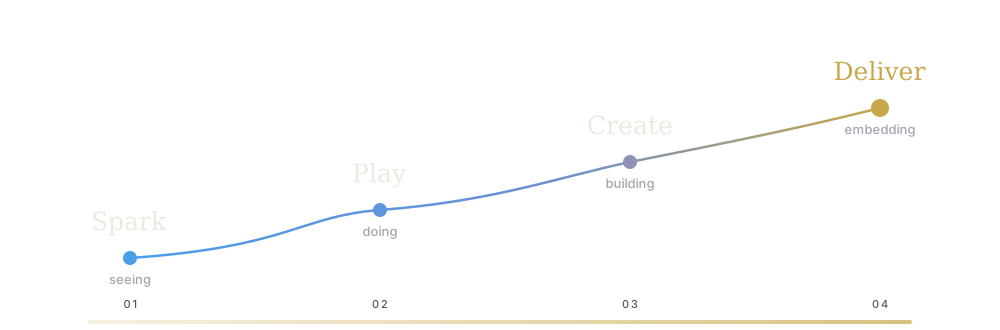
From inspired to doing. Not thinking about AI one more time, but taking it in hand: playing, trying things out, training, until it becomes normal.
Where possible, Play starts with a deep dive into your sector: what is going on, what is possible, where it goes wrong. We build that per assignment. Not a template with a different logo on it.
After that people get to work themselves, in two ways.
Online, in their own time and place. A game with short missions and immediate feedback. Wherever and whenever it suits.
In the classroom, in groups of twenty at most. Training such as AI as a team of colleagues, and a training on prompting.
What it produces. At the end everyone hands in something concrete from their own work: an opportunity to improve something, an agent they built, a way of working they set up. Not AI taking over the work, but someone working with AI. That is the proof that they walked through the third door.
That is assessed, and it earns a certificate, and with it access to the next phase.
The improvements identified in Play are the raw material here. With guidance they are worked out into real proposals: what it is, who leads it, who works on it, what it produces, how feasible it is, where the risk sits.
We guide the business case and the ROI along the way. Not as arithmetic for its own sake: together with the proposal itself and a working test, that is what the committee bases its choice on.
Those proposals go to a committee from your own organization: management, operations, tech and compliance, for example. They choose, not us.
What gets through is tested further: do the assumptions hold in practice, can it scale, and is it actually allowed: data, governance, law and regulation. Then a final round, pitched with something working alongside it.
What it produces. Two or three use cases chosen and tested by your own organization. Not a list of ideas. Proposals with an owner and a decision behind them.
What was chosen in Create goes into practice here: validate, experiment small, scale up, embed. You build and implement it yourselves, with your own team or supplier. We are mainly there at the start and at the end: at the question of whether it is right, and at the question of whether it lasts.
Alongside that we set up the Lab: a fixed process that takes the next AI solution through the same route. Roles, a recurring cycle, and governance built in rather than bolted on.
Anyone who wants to go beyond AI alone can widen this to innovation as a whole, a separate and heavier program.
What it produces. Use cases that are in structural use, and an organization that can run the next round itself.
Not a phase, but a line that runs straight through all of it, and weighs more heavily the further you go.
At Validate it is about whether your assumption holds. At Experiment it must already be settled what may and may not be done with which data. At Scale, governance effectively decides whether you may scale at all. And at Embed it becomes part of how you work.
That is why we treat this as a separate track, available on its own, and not something you arrange at the end.
Hundreds of professionals there go through Spark and Play.
Spark runs in groups of twenty at most, over and over, until everyone has been. Ninety minutes per group, no presentation. A conversation that ends with questions instead of answers.
In Play there is first a deep dive built specifically for their sector. Then the game, online and in their own time, and the classroom training in those same groups of twenty.
At the end everyone hands in something from their own work, and that is assessed. Not on how clever the application is, but on one question: does this person use AI as a partner, or do they let it take the work over.
From those groups, some go on to Create. Not everyone is a creator, and they do not need to be. Those who are take the next step.
What that produces: hundreds of people who not only know what AI can do but have worked with it themselves, and a stack of concrete starting points from their own practice.
How long the whole thing takes depends on how big your organization is and where you start. We determine that together.
After that you will know whether this fits you.
Get in touch